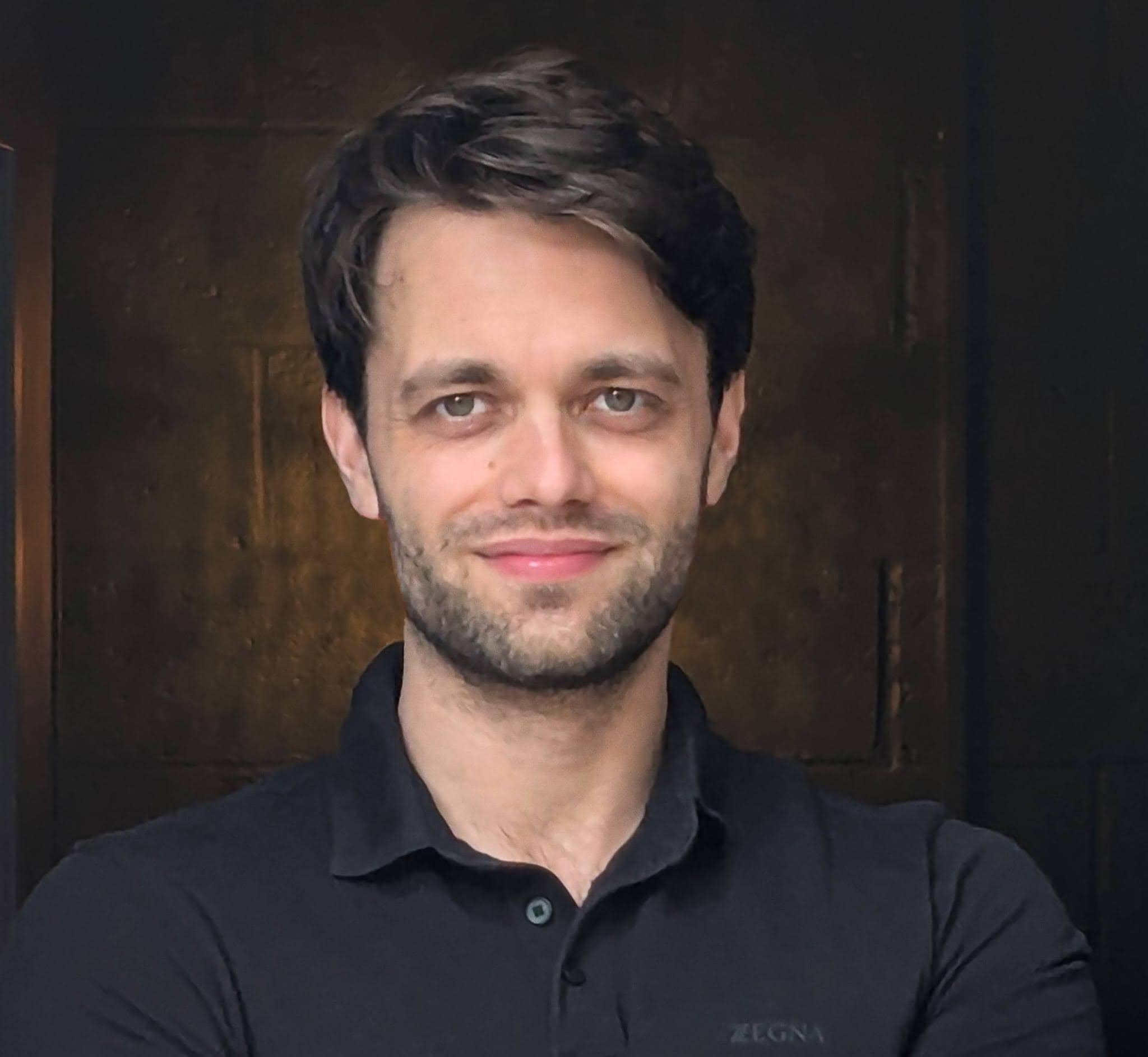
Welcome to my webpage! I am a machine learning researcher, statistician, and professional curious person. Currently, I am working on machine learning for biology and I am excited to be part of the team at Latent Labs, where I'm working on developing frontier models for biologics.
Previously, I had the opportunity to contribute to Altos Lab and their mission of transforming medicine through cellular rejuvenation programming, worked as a Research Scientist at Improbable, where I gained valuable experience applying my skills to real-world problems. During my time at Improbable, I also served as an Assistant Professor in Statistics at Durham University, where I enjoyed contributing to the academic community and mentoring the next generation of statisticians and machine learning practitioners. My research interests lie at the intersection of statistics, machine learning, and probability theory, with a particular focus on applications in the sciences. I'm also intrigued by the philosophical aspects of science and enjoy digging into the foundations when the opportunity arises. Recently, I've been working on projects involving generative AI, including large language models, embeddings, and diffusion models. I obtained my DPhil (the Oxford equivalent of a PhD) from the Department of Statistics at the University of Oxford. Below, you'll find a list of my publications, highlighting my contributions to the field.
News
-
Two of my papers have been accepted to the Workshop on the Philosophy of Machine Learning (PhilML) at ICML 2026.
Reality and Practice: A Relational Reading of the Platonic Representation Hypothesis
I revisit the Platonic Representation Hypothesis — the claim that large models trained for different objectives converge on a shared statistical model of reality. I accept the empirical convergence but argue the Platonic framing is not forced by the mathematics, and offer a Wittgensteinian alternative: categories are useful compressions linked by family resemblance, and the convergent geometry reflects convergence toward a relational system of use, shaped by human practice under physical constraints. Read on OpenReview.
Measuring the Ruler: Reading Benchmark Saturation as Evidence
I argue that the inference from a benchmark score to a capability claim is conditional on the system being evaluated: a benchmark supports a claim only once the benchmark–system pair has been validated. On this view, benchmark saturation is not merely a sign that harder tests are needed — it is evidence about the validity relation itself. Illustrated on MMLU, GSM8K, and HumanEval, the paper proposes a short Validity Transfer Report that benchmark papers can use to make these assumptions explicit. Read on OpenReview.
-
I'm serving as an Area Chair for NeurIPS 2026.
-
We've launched Latent-Y at Latent Labs, the first lab-validated AI agent for drug design, which I lead. Powered by Latent-X2, it autonomously designs antibodies and therapeutic peptides from natural-language prompts — compressing weeks of expert work into hours.
-
The paper PerturBench: Benchmarking Machine Learning Models for Cellular Perturbation Analysis from my time at Altos Labs has been accepted to Neurips 2025 Datasets and Benchmarks Track.
-
Our team at Latent Labs as published a preprint for our new all-atom protein design model Latent-X, where we demonstrate lab-validated state-of-the-art performance for the de-novo design of cyclic peptides and minibinders! Also check out the platform.
Selected publications
-
Latent-Y: A Lab-Validated Autonomous Agent for De Novo Drug Design
-
Drug-like antibodies with low immunogenicity in human panels designed with Latent-X2
-
Latent-X: An Atom-level Frontier Model for De Novo Protein Binder Design
-
Approximate Bayesian Computation with Path Signatures
-
PerturBench: Benchmarking Machine Learning Models for Cellular Perturbation Analysis
-
AnoDDPM: Anomaly detection with denoising diffusion probabilistic models using simplex noise
-
Denoising diffusion probabilistic models on SO(3) for rotational alignment
-
Learning Multimodal VAEs through Mutual Supervision
-
Robust neural posterior estimation and statistical model criticism
-
Optimal scaling of random walk Metropolis algorithms using Bayesian large-sample asymptotics
-
Amortised likelihood-free inference for expensive time-series simulators with signatured ratio estimation
-
Capturing Label Characteristics in VAEs
-
Large-sample asymptotics of the pseudo-marginal method